Telescopes and Optics Overview...
Why do most Professionals choose the Ritchey-Chrétien design?
The Ritchey-Chrétien optical design is a specialized Cassegrain telescope designed to eliminate coma, thus providing a relatively large field of view as compared to a more conventional configuration. An RC has a hyperbolic primary and a hyperbolic secondary mirror. Since Ritchey-Chrétien optics are two mirror optical systems, they have no Spectral Dispersion or Chromatic Aberration. Furthermore, the Ritchey-Chrétien does not require refractive optics allowing for a much wider spectral range from UV to Long Wave Infrared making the RC a truly versatile design. It's easy to see why the Ritchey-Chrétien design is so widely used by Professionals.
The curvature of the two mirrors in the Ritchey-Chrétien design is described by the following relationships:
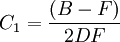
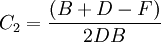
where:
- C1 and C2 are the Schwarzschild deformation coefficients for the primary and secondary mirrors, respectively,
- F is the effective focal length of the entire system,
- B is the back focal length, or the distance from the secondary to the focus, and
- D is the distance between the two mirrors.
Additionally:
- Only two surfaces for less light loss - Catadioptric type optics have 4 surfaces - two are glass. Corrected Cassegrains and APOs can have six or more surfaces in their refractive elements. Each surface degrades the wave front and amount of light getting to the focal point.
- No refractive elements - A Ritchey-Chrétien is color free . Glass scatters light, especially in IR where CCD cameras are most sensitive. A Ritchey-Chrétien has no refractive elements and can reflect light from Ultra-Violet to Long Wave Infrared (100nm - 12mu)!
- Flatter Field - The lower the amplification factor of the secondary mirror, the flatter the field. For example, the RC has a 2.7x secondary, whereas, a Schmidt-Cassegrain has a 5x secondary. The RC has a much flatter field! And where a large flat field is needed for 50mm square detectors, RCOS offers an optional Field Flattener/Corrector (FFC) that may be used when needed.
- Smaller Spot Size on and off axis - Examine this spot diagram to see the difference!
Optics
Powered by True Ritchey-Chrétien Optics
We use only the finest optics available in the Ritchey-Chrétien design featuring:
- Expert Manufacturing - Our optics are manufactured by some of the most experienced opticians in the world, and guaranteed to be better than 1/20th wave RMS for Computer Polish optics and 1/40th wave RMS for ION Milled optics!
- Zero Expansion Materials - All mirrors utilize zero expansion materials such as Astro-Sitall, Zerodur, or ULE. These materials ensure the mirror will maintain shape and figure during changing temperatures.
- Certified Optics - Interferometric testing and fringe analysis data is provided with every set of optics.
- Flexibility - Available in any configuration or f/ratio, these true Ritchey-Chrétien optics are the finest in the world!
Why is Optical Testing and Certification Important?
Each RCOS telescope comes with an Interferogram provided by the optician. The Interferogram is a certificate of optical quality, specific and unique only to that set of matched and indexed optics. This is the only way to quantify optical performance. Interferometry is not only used to measure the final results, it is also used and needed during manufacturing.
Most manufacturers of low cost, mass produced telescopes do not test their optics. They simply polish the mirrors and lenses to a specification and then hope that the completed optical system is satisfactory. But without interferometric testing, there is no way of knowing. So when a manufacturer says their optics are diffraction limited, ask them to show you the test results.
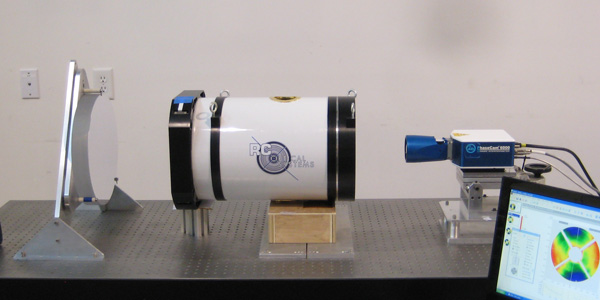 Alignment and interferometric testing of an afocal DK shown above.
For critical applications or customer requirements, RCOS goes a step further and will align and test the optics in place with our 4D interferometer.
Why are Near Zero Expansion Optics Important?
All RCOS mirrors are made of near zero temperature coefficient material to maintain their precise optical shape during temperature changes. Astro-Sitall, Zerodur and ULE type ceramics used by RCOS, have a temperature coefficient of near 0.0 ± 0.6 x 10⁻⁷ while Pyrex, which inexpensive telescopes use, have a temperature coefficient of 32.5 x 10 - 7. This means the optical performance of RCOS telescopes are maintained over any temperature excursion. It is not unusual for Pyrex telescopes to lose star roundness as one gets to the extremes of the FOV, as with larger format image sensors. With Pyrex, focusing is touchy and hard to maintain as is optical alignment. Pyrex is good for baking but not for telescopes.
What other types of optics are available from RCOS?
Although RCOS specializes in high performance optics such as the Ritchey-Chrétien, we also offer other optical prescriptions and engineering services to meet customer requirements including:
- Classical Cassegrain
- Mersenne (AFocal)
- Dall-Kirkham
- Off-Axis Telescope Systems
- Off-Axis Parabolas
- Beam Expanders
Why an RCOS Ritchey-Chrétien?
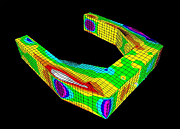
Design, Engineering, Modeling and Finite Element Analysis (FEA).
EVERYTHING we manufacture is designed in CAD (Computer Aided Design), specifically SolidWorks. Every part and component is assembled into a model before we start machining. Rather than a "trial and error" or "overkill to be sure" approach, we design, engineer, and model all of our critical components. This ensures that you get the best product or part for its intended purpose. For example, we needed a low frequency, high strength fork mount for out latest .6m class telescope. By engineering and modeling, we were able to get the frequency and flexure to remarkable limits!
Once the component is designed and modeled and tested, its machined out of T6-6061 (or 7075) Aluminum, 1023 Carbon Steel or Annealed Ti-8Mn Titanium.
Customer Support
RCOS products are backed with unparalleled customer support. From personal one-on-one service to full product documentation, we strive to make certain you get the most out of your investment. In addition, RCOS owners enjoy the support of hundreds of other RCOS customers, a resource that is second to none.
RCOS Optical Tube Options:
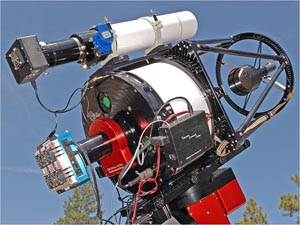
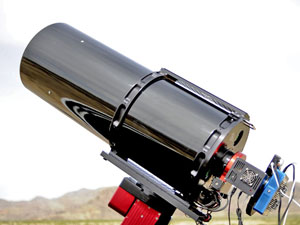
Astronomy Use Truss verses Tube Design
Carbon Truss Telescopes: We have been able to quantify a truss telescope does have better intrinsic seeing than a tube telescope. There is little chance of trapping a micro climate (heat causing tube currents) inside of a truss. This is the foremost reason why most all large professional telescopes are trusses. Truss telescopes also offer a lower cross section or "sail" area than a tube telescope, so they are less vulnerable to wind. And a truss is easily maintained as all components are readily accessible.
Carbon Tube Telescopes: The tube telescope is slightly better athermalized than a truss as carbon tubes offer the highest stability since there is less aluminum. They also offer better protection from stray light and are especially useful for daytime imaging.
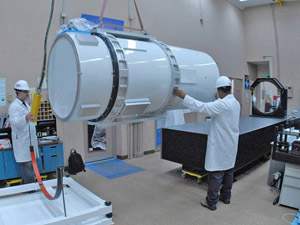
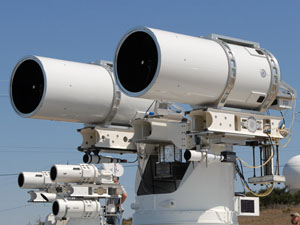
Military (Ruggedized) Carbon Nomex Tube Telescopes
Reinforced with Nomex honeycomb, these are the most durable carbon scopes made in their class. Designed for Mobile Missile Tracking Mounts, they can withstand the most punishing conditions. These instruments are designed for day or night use, visible to long wave infrared (demonstrated out to 12 microns), and endure high speed slewing up to 90 degrees per second.
Collimation of Ritchey-Chrétien Optics
"Is it difficult to collimate a Ritchey-Chrétien?" Our competitors would suggest that it is. Collimation can be challenging due to the fact that there are two mirrors to adjust - the primary and secondary. So we developed a procedure that allows you to collimate your Ritchey-Chrétien telescope quickly and easily. We also make this procedure available to owners of other brands of Ritchey-Chrétien and Cassegrains telescope (see: collimation on the RCOS web site). This is a 10 minute procedure using the Takahashi Collimating Scope.
Optical Tube
Focus Stability and Low Thermal Mass
The telescope and telescope tube also play a vital role. Everything matters. So we carefully considered all aspects of the design to develop a system that functions to it's fullest potential.
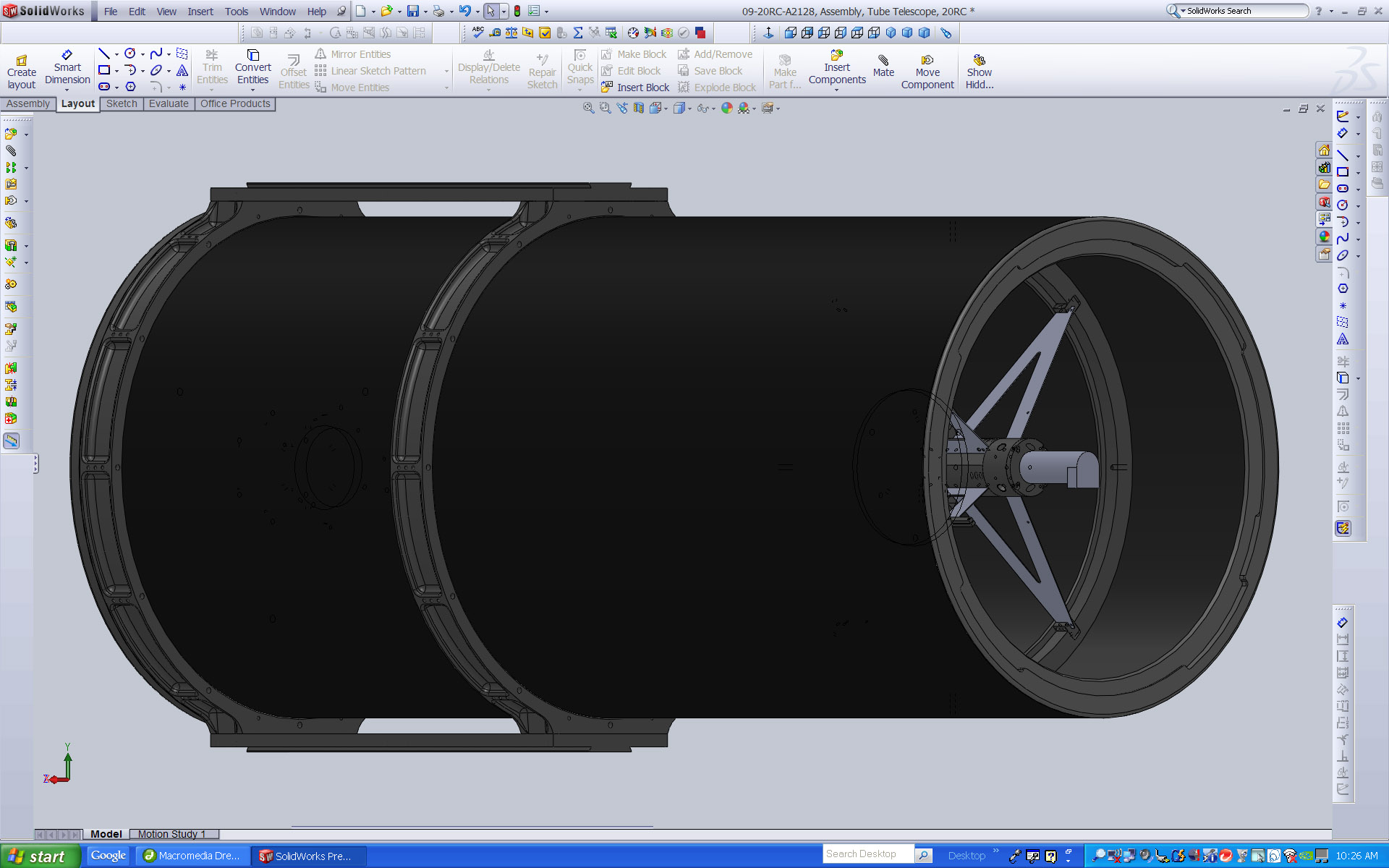
Carbon Fiber = Low thermal mass, low expansion, and stable focus
Coefficient of Expansion... (x / unit length / Deg. C x 10 -6 power)
Aluminum = 18.35
Steel = 11.0
Titanium = 8.5
Invar 1.1
Carbon Fiber (High Modulus with Epoxy) = 0.9
Typical aluminum and fiberglass telescope tubes both have a high coefficient of expansion and unstable mirror spacing. Telescopes made of such products require frequent refocusing during the night as the temperature changes. As an example, an F/9 Cassegrain has a 9x affect in back focus relative to mirror spacing. That is, a 1x change in mirror spacing changes the back focus 9x. So when the temperature changes, so does the telescope's focus.
Carbon does not suffer from these instability problems. That's why we choose to use an optical tube made of carbon graphite fiber. Carbon has a very low coefficient of expansion and also has excellent thermal properties. Focus and forget. Night after night, month after month!
RC Optical Systems was the first manufacturer to introduce commercially available Carbon Tubes / Carbon Trusses for telescopes. And we continue to be the worlds largest manufacturer of Carbon Tube / Carbon Truss Ritchey-Chrétien Telescopes!
Ask for Carbon Only
Other manufacturers have since introduced carbon fiber tubes. Some of these other carbon tubes are made with a high epoxy content, fiberglass, layers of Styrofoam, or even metallic components. These additional materials are not consistent with the low expansion and thermal properties of carbon fiber and may even negate the reason for using carbon. And to take advantage of the near zero CTE of carbon fiber, it must be laid up correctly.
Secondary Focuser
Cassegrains have a two mirror, amplified optical system. Mirror spacing and backfocus are directly related to each other. If you change one, it affects the other. Different accessories or cameras will change the backfocus, which will change the required mirror spacing.
Since an Ritchey-Chrétien is part of the Cassegrain family, a secondary mirror focuser is required for optimum optical performance. All of our telescopes are shipped with a secondary focuser as standard equipment.
Our secondary focuser is an original RCOS design that allows the secondary mirror to move in precise increments without backlash, wobble, or play. This is a true "zero image shift" focuser. The absolute precision is due to four case hardened stainless steel linear races riding on eight linear ball bearings. Solid and very, very precise.
As with most of our components, the secondary support is machined on CNC mills to ensure precision. Each secondary is then laser aligned when installed.
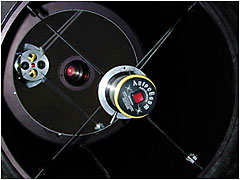
In 1999, we offered a motorized version of the Secondary Focuser to control the secondary's position. This controller was developed by RCOS to precisely move the mirror in increments of 1/10,000 of an inch!
In 2001, we have gone a step further with the introduction of the"Telescope Command Center" (TCC-II). The TCC could now control the Servo DC Secondary Focuser by use of your PC. It can be operated remotely. The TCC powered linear actuator now has a resolution of 1/40,000 of an inch!
And in 2010, we introduced the latest and most up to date controller, the "Telescope Interface Module" (TIM). The TIM was developed from scratch using the latest technology. As with the TCC, it is computer controlled by your PC or can be used with the hand controller. The TIM offers the following functionality:
- Secondary Mirror Focuser Control.
- Monitors temperature and controls dew heaters and fans accordingly.
- Controls the Precision Instrument Rotator.
- Robotic operation of the Primary Mirror Cover.
The TIM also comes with a user friendly graphical user interface (GUI) and extensive online documentation.